Tuesday November 10, 2026 – Nidia Lauzon, PhD
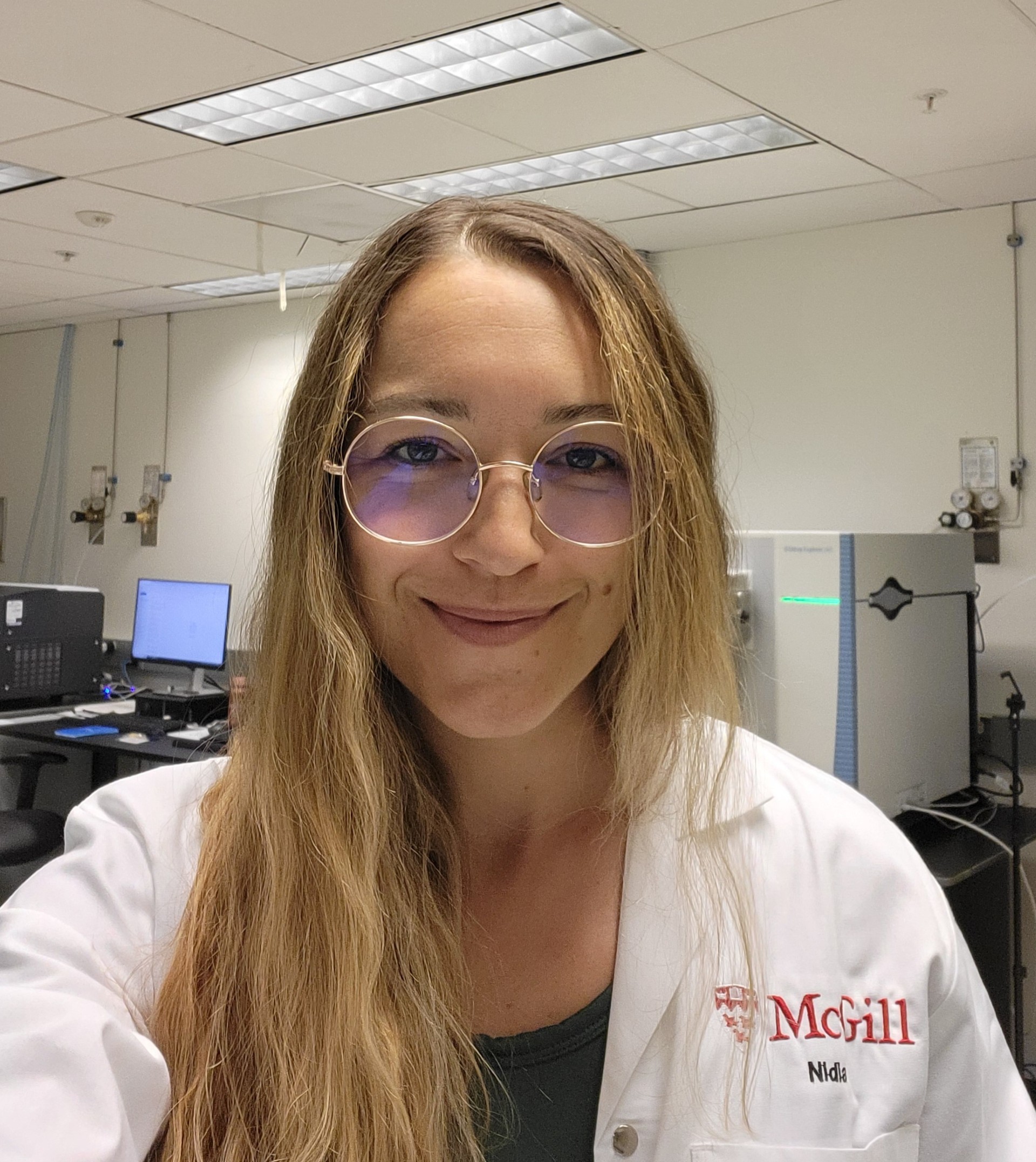
Nidia Lauzon, PhD
Metabolomics Core Manager, McGill Metabolomics Core — Victor Phillip Dahdaleh Institute of Genomic Medicine, McGill University
From Genomics and Proteomics to Metabolomics: Expanding Multi-Omics Capacity at McGill’s Institute of Genomic Medicine
Abstract
Over the past two years, we have established a multi-platform metabolomics and lipidomics operation at the Victor Phillip Dahdaleh Institute of Genomic Medicine, McGill University, extending the Institute’s existing genomics and proteomics capabilities to support large-scale multi-omics studies. The platform combines targeted LC-MS/MS and GC-MS/MS quantification with untargeted lipidomics, supported by automated sample preparation and dedicated data-processing workflows designed for high-throughput analysis.
We demonstrate the application of this infrastructure through an ongoing collaboration profiling the plasma metabolome of the BQC19, a pan-provincial, multicenter COVID-19 biobank with longitudinal samples collected across Quebec. A total of 1,595 plasma samples were analyzed over 10 weeks, comparing participants with persistent post-COVID symptoms with matched recovered and comparison groups across follow-up timepoints ranging from less than one month to two years post-infection. Samples were processed in sequential batches using a standardized quality-control workflow incorporating blanks, pooled QC samples, internal-standard normalization, and monitoring of analytical drift and batch consistency. The resulting data support both cross-sectional group comparisons and within-patient longitudinal analyses across early and late follow-up visits.
This presentation describes the development of the platform and its analytical workflow, using the BQC19 cohort as a case study to illustrate how reproducible, high-throughput metabolomics and lipidomics can contribute to large-scale clinical multi-omics research.
Biosketch
She holds a Ph.D. in Chemistry from Université de Montréal, completed in 2018 under the supervision of Professor Pierre Chaurand. She subsequently served as an imaging mass spectrometry expert at the Research Institute of the MUHC before joining Theratechnologies as a Scientific Researcher, where she developed quantitative LC-MS and LC-MS/MS methods for preclinical research. With more than a decade of experience in mass spectrometry, she has worked across a broad range of analytical projects, with expertise in method development, quantitative analysis, and translating complex instrumentation into reliable, high-throughput workflows.
Date
Date(s) - November 10, 2026
6:00 pm - 8:00 pm
Emplacement / Location
Université de Montréal - Campus MIL (Beer and pizza at 18h, conference at 19h in A-5502)
Groupe de discussion en spectrométrie de masse de Montréal (GDSMM)
Le groupe de discussion sur la spectrométrie de masse de Montréal (GDSMM) est un organisme à but non lucratif qui offre un forum favorisant les interactions locales, nationales et internationales entre les scientifiques oeuvrant en spectrométrie de masse. Le GDSMM organise des séminaires scientifiques et des forums de discussion présentant les derniers développements en recherche fondamentale et appliquée en spectrométrie de masse. Une réunion annuelle du GDSMM qui regroupe les étudiants et les post-doctorants a lieu à Montréal chaque printemps et offre une opportunité unique de réseautage en plus d’accroitre la visibilité et la sensibilisation aux contributions locales en spectrométrie de masse.
Montreal mass spectrometry discussion group (MMSDG)
The Montreal mass spectrometry discussion group (MMSDG) is a not-for-profit organization that provides a forum to promote local, national and international interactions among scientists involved in mass spectrometry. MMSDG sponsors scientific seminars and forums to present the latest developments in basic and applied research in mass spectrometry. An annual MMSDG meeting that regroups students and postdoc is held every spring in Montreal, and provide a unique networking opportunity to participants and enhance the visibility and awareness of local contributions in mass spectrometry.
 |
|
 |
 |
 |
 |
 |
 |
 |
 |

|
|
 |
|

|
|